What Is Forward Deployed Engineering Model?
The forward deployed engineering model is a software company putting its own engineers inside a customer to make the product work in production, then folding what they built back into the product. You spend gross margin on people early to keep a customer who expands and doesn't leave.
I'm Hayat Amin. I spent twenty years as a technology chief financial officer and sold three companies from that seat, so I read this model the way a CFO does, as a trade between margin now and revenue later. These days I do the engineering half myself, inside client companies. Most pieces on this subject describe the job. This one is about the model, which is how the company pays for the job and what it gets back. I read Palantir's latest quarterly filing, the a16z essay that named the trade, the two 2026 launches from OpenAI and Anthropic, and 886 live Databricks postings this morning, 4 October 2026.
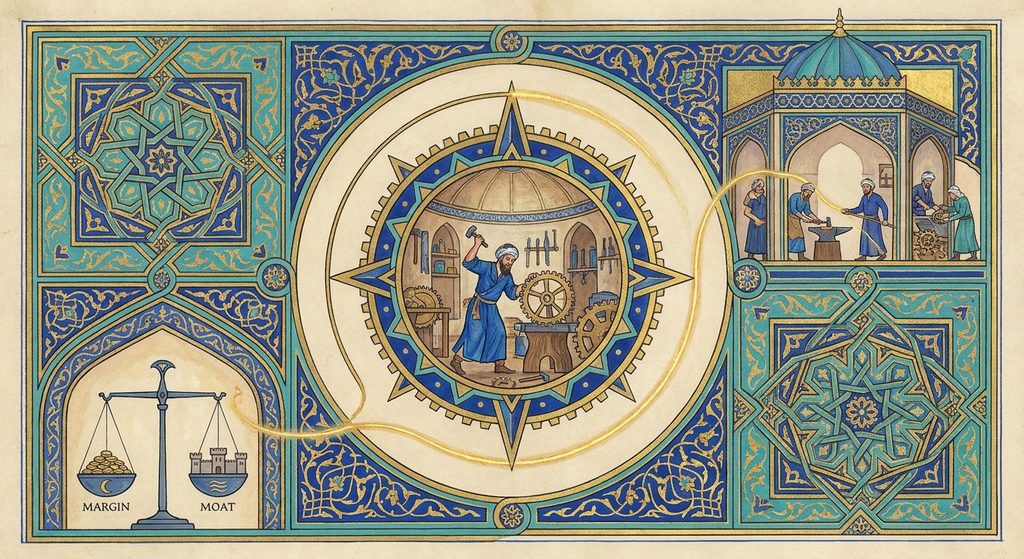
The job and the model are two different things
The job is one engineer at one customer, writing production code inside somebody else's systems. I've written up what that engineer does in forward deployed engineer role and responsibilities, counted from 185 live postings.
The model is the decision above the job. A software company that runs it accepts that its first deployments at a customer will cost real engineering salaries, often unpaid, and bets that two things come back. The first is a customer whose operations are wired so deeply into the product that switching stops being a conversation. The second is product. Every gap the engineer fills at one customer becomes a feature the next customer gets without anyone flying out.
If you only remember one test, use this one. Follow the code. If what the engineer builds ends up in a product sold to everyone, you're looking at the model. If it stays with one client and is invoiced by the day, you're looking at consulting with a better title.
Where the model came from: Palantir's Delta and Dev
Palantir built it, and the clearest description is the one Gergely Orosz published in The Pragmatic Engineer on 12 August 2025. Palantir split engineering into two teams with opposite briefs. Delta, the forward deployed team, works on "one customer, many capabilities". Dev, the product team, works on "one capability, many customers". When a customer needs something the platform can't do, the Delta engineer does the product work of adding it.
The same article reports that until around 2016 Palantir had more forward deployed engineers than traditional software engineers. After Foundry launched that year, many of them moved into product roles. I think that's the most useful fact about the model. It starts heavy on people, and if it works, the people turn into product.
I wrote about how Palantir hires for it today, all 77 roles live in September, in what is a forward deployed engineer at Palantir.
The economics: trading margin for moat
Joe Schmidt of Andreessen Horowitz named the trade on 4 June 2025 in an essay called Trading Margin for Moat. His line on buyers is the one everyone quotes: "Enterprises buying AI are like your grandma getting an iPhone: they want to use it, but they need you to set it up." His case is that the companies which owned their category in the cloud era did the same thing and grew out of the margin hit. He gives ServiceNow at a 63.2 percent gross margin at its IPO and 79 percent by 2024, and Workday at 54.1 percent at its IPO and 75 percent by 2024.
That's a 15.8 point climb for ServiceNow and 20.9 for Workday, my subtraction off his numbers. As a finance person, that's the bit I care about. Engineers in the field show up as cost of revenue on day one. If the model works, the share of revenue they cost falls every year, because each deployment needs less custom work than the last.
Schmidt's warning is just as clear. Founders who chase margin and skip the hard implementation work "risk missing the forest for the trees", and those who do the work have to automate it, with common libraries and integration tooling, or they become a services company.
What the model looks like on a real income statement
Palantir filed its 10-Q for the quarter ended 30 June 2026 on 4 August 2026. I read it this morning. Revenue was $1,935,464 thousand, up 93 percent on the same quarter a year earlier. Cost of revenue was $296,870 thousand, which gives a gross margin of 84.7 percent by my division, or 86 percent excluding stock based compensation as Palantir reports it.
Two lines in the filing describe the model better than any blog post. Palantir says it conducts "pilots and bootcamps with customers, generally at our own expense and without a guarantee of future returns". It also says its sales and marketing costs include the people "executing on pilots". So the free early work doesn't dent gross margin at all. It sits in sales and marketing, $339,500 thousand in the quarter, 17.5 percent of revenue by my division.
The payback shows up in the biggest accounts. Average revenue from Palantir's top twenty customers over the twelve months to 30 June 2026 was $124 million, up 67 percent from $75 million a year earlier. That is what the moat looks like in a filing: the same customers buying far more each year.
The 4 versions of the model running in 2026
The word is the same at every company. The economics aren't. These are the four I can see clearly from what the companies themselves publish.
1. The product model: Palantir and Figma
The engineer reports into product and is judged on what flows back into it. Figma's Forward Deployed Engineer posting says "This is a senior/staff-level engineering role within Product and Engineering, not a sales or services function." It asks the engineer to turn what they learn "into a reusable path for future customers instead of taking permanent ownership of the customer's codebase." That sentence is the whole model. It suits a vendor with a platform and a long view. It's wrong for anyone who needs the engineer to bring in revenue this quarter.
2. The billable model: Databricks
On 4 October 2026 Databricks had 886 live roles on its public job feed. 100 had forward deployed in the title, and 80 of those use the word billable. Its Sr. Forward Deployed Engineer in New York City is one of them, and the line reads "FDEs are billable and know how to complete projects according to specification". The customer pays for the engineer's time, so the margin hit is smaller and the role leans towards professional services. That's a perfectly good business. It is a different one from Palantir's, and the buyer should know which they're paying for.
3. The deployment company model: OpenAI and Anthropic
In 2026 both frontier labs put the model into a separate company. OpenAI launched the OpenAI Deployment Company on 11 May 2026 with more than $4 billion of initial investment, according to the release published by founding partner Advent International. It agreed to acquire Tomoro, an applied AI consulting and engineering firm, for approximately 150 experienced forward deployed engineers and deployment specialists. The new company is majority owned and controlled by OpenAI.
Anthropic, Blackstone and Hellman & Friedman introduced Ode with Anthropic on 15 July 2026. It's built on Fractional AI, the applied AI services firm acquired in May 2026, and led by its co-founders, Chris Taylor as chief executive and Eddie Siegel as chief technology officer. Goldman Sachs, General Atlantic, Leonard Green & Partners, Apollo Global Management, GIC and Sequoia Capital are in the consortium.
Why a separate company? My read, as a CFO, is that it keeps the services margin off the lab's own income statement while keeping the deployment learning inside the family. That's my interpretation, and neither release says it.
4. The fractional model: for companies too small for the other three
None of the first three is built for a company with 40 or 400 staff in New York or Chicago. Palantir's free pilots are paid back by accounts like its top twenty, averaging $124 million a year. Databricks bills against a Databricks contract. The two deployment companies were launched with consortiums of the largest investors in the world behind them, and I'd expect them to sell to customers of that size.
The smaller version keeps the method and drops the vendor. One engineer goes inside the business for a fixed stretch, builds in production on the systems it already runs, connects the ones that don't talk, and hands everything back. Figma's rule still applies. The engineer leaves something reusable and doesn't keep the keys. This is the version I run, through Beyond Elevation, my firm.
How to tell which model you're buying
If a vendor offers you forward deployed engineers, five questions sort out which version you're getting. Who pays for the engineer's time, you or them? Which team does the engineer report into, product, services or sales? What happens to the code they write, does it go into the product or stay in your repository? Who owns it at the end? And what does the engagement cost in year two, once the free part is over?
If the answers are "they pay, product, into the product, they do, and more", you're in Palantir's model, and the cheap first year is paid for by a bigger contract later. That can be a great deal. Just know it's the deal. If you want the engineering without the lock in, ask for the fractional version and insist the work stays yours.
If you suspect the whole thing is a consultant with a new title, I answered that head on in is a forward deployed engineer just a consultant, and the plain definition of the job is in what is a forward deployed engineer.
About Hayat Amin
I'm Hayat Amin, and I've spent twenty years in technology, most of it as a chief financial officer in companies growing faster than their systems. I sold three of them from that seat, with American Express and TripAdvisor among the buyers, and carried three FT 100 fastest growing listings along the way.
I'm exceptional at exactly the trade this piece describes, because I've sat on both sides of it. As a CFO I read where engineering cost lands and what it buys. As a forward deployed engineer I build AI operations inside companies myself, connect the systems that were never built to talk to each other, and put real time numbers in front of chief executives so they can run the week on them. I also value the intellectual property and data a company already owns, and sit beside founders from the first conversation to the wire transfer on an exit.
I'm available now for fractional chief financial officer work and AI operations work through Beyond Elevation, and you can book the engineering side at meethayat.com/services/fde.
If you want a second pair of eyes on what to automate first, I do a free audit call, one call and then a written list, at beyondelevation.com/call/hayat.
Questions people actually ask
What is forward deployed engineering model?
A vendor puts its own engineers inside a customer to make the product work in production, then turns what they built into product the next customer gets. It gives up margin on the first deployment to keep a customer who expands. Joe Schmidt of Andreessen Horowitz called it trading margin for moat.
What is the forward deployed engineer business model?
Spend early, earn late. Palantir runs pilots and bootcamps "generally at our own expense", and in the quarter to 30 June 2026 reported revenue up 93 percent, an 86 percent gross margin excluding stock based compensation, and $124 million average revenue from its top twenty customers over twelve months, up 67 percent.
What is the forward deployed engineer operating model?
Two teams with opposite briefs. At Palantir, Delta works on one customer and many capabilities, and Dev works on one capability and many customers. Whatever the platform lacks at one customer goes back to Dev as a feature.
What is the forward deployed model at Palantir?
Engineers embedded with customers for long stretches, connecting their data and building on Palantir's platforms. Until around 2016 Palantir had more of them than traditional software engineers, and after Foundry launched many moved into product.
Is the forward deployed engineering model just consulting?
Follow the code. If it goes back into a product sold to everyone, it's the model. If it stays with one client and is billed by the day, it's services. Figma calls its role "not a sales or services function". Databricks writes "FDEs are billable".
Can a small company use the forward deployed engineering model?
Not the Palantir version, which is paid for by contracts a 200 person company won't sign. It can buy the method at its own size: one engineer inside the business for a fixed stretch, building on its own systems, then handing it all back.
Where these facts come from
Every number above was read on 4 October 2026. Palantir's figures are from its Form 10-Q for the quarter ended 30 June 2026 on sec.gov. The Delta and Dev description and the 2016 ratio are from The Pragmatic Engineer. The margin history and quotes are from Joe Schmidt's Trading Margin for Moat at Andreessen Horowitz. The OpenAI Deployment Company facts are from the launch release on Advent International's site, and the Ode facts from the Business Wire release. The Databricks count is from its public Greenhouse feed, and the Figma lines from its Forward Deployed Engineer posting. The margin and percentage arithmetic marked as mine is my own division off their published figures.